Contract Manufacturing India: Own Unit vs Outsourcing — Which Makes More Sense?
For any pharma or nutraceutical brand owner, contract manufacturing India offers a serious alternative to building your own production unit — but knowing when to use it and when to move beyond it is where most brands get stuck.
You’ve validated your product. You have a market. Business is growing. And somewhere in a planning meeting or a late-night spreadsheet session, someone asks — should we just build our own manufacturing facility?
It’s a legitimate question. And it deserves a proper answer rather than a reflexive one.
Both paths work. Own manufacturing has built some of India’s most successful pharma companies. Contract manufacturing India has built plenty of others. The decision isn’t about which model is better in general — it’s about which one makes sense for your brand, at your stage, with your resources and your goals.
Why Contract Manufacturing India Works for Most Brands Early On
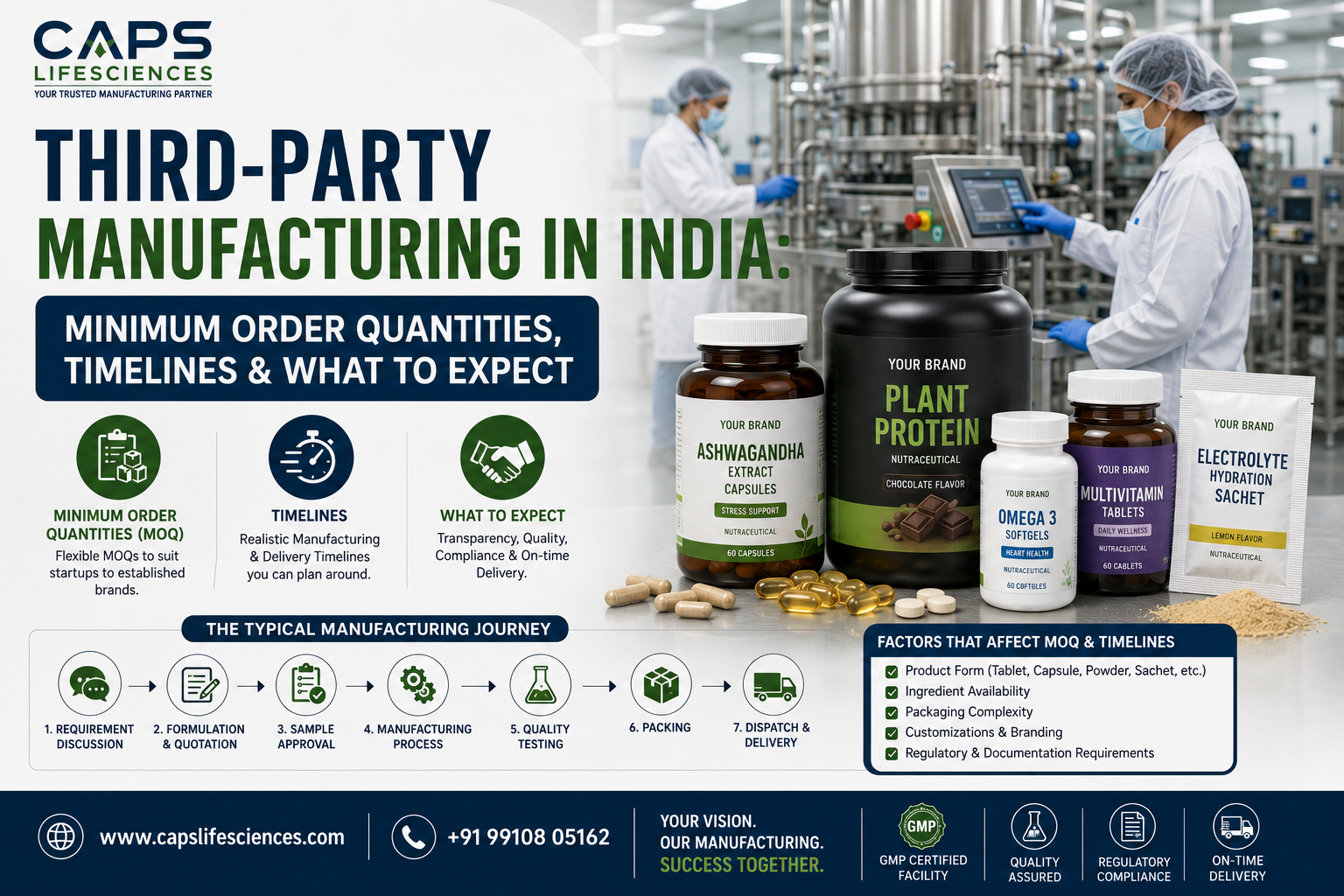
Contract manufacturing — also called third-party manufacturing — means you outsource production to a certified facility that manufactures your product under your brand name. You own the brand, the formulation, and the market. The manufacturer owns the facility, the equipment, the compliance infrastructure, and the production expertise.
For most pharma and nutraceutical brands, contract manufacturing India is how they start. And for many, it’s how they continue operating even at significant scale — not because they can’t afford their own facility, but because the model genuinely serves them better.
Capital Efficiency With Contract Manufacturing India
Setting up a WHO-GMP certified pharmaceutical manufacturing unit is not a small investment. Depending on dosage forms, capacity, and compliance requirements, a greenfield facility can cost anywhere from ₹5 crore to ₹50 crore or more — before you’ve manufactured a single unit.
Contract manufacturing India lets you redirect that capital toward the parts of the business that directly drive revenue. A brand with strong distribution, smart marketing, and genuine consumer trust generates more long-term value than one that tied up its resources in a factory. According to WHO GMP guidelines, compliant manufacturing infrastructure alone demands significant ongoing investment to maintain certification standards.
Speed to Market
A new manufacturing facility takes two to four years from decision to first commercial batch — site selection, construction, equipment procurement, installation, qualification, regulatory inspection, and license approval all stack up.
A contract manufacturing India partner with an existing approved facility can take your product from formulation finalization to first batch in weeks. If your market opportunity is time-sensitive, that speed difference is commercially significant.
Access to Expertise and Infrastructure
An established contract manufacturing India facility brings validated processes, established supplier relationships, and a quality team that has already solved the problems you’d be solving from scratch. For brands entering a new dosage form or therapeutic category, this accumulated expertise has real value.
Flexibility as You Scale
With contract manufacturing India, your production volume is a variable cost rather than a fixed one. If sales slow down, you don’t have an idle factory eating overhead. If sales accelerate, a good manufacturing partner scales batch frequency to match demand.
What Own Manufacturing Actually Gives You
The case for building your own facility is real — under the right conditions.
Full Process Control
When you own the facility, you control every variable — raw material sourcing, process parameters, quality benchmarks, batch scheduling. You’re not dependent on a third party’s capacity calendar or business priorities.
For brands where the formulation is proprietary and the process is genuinely differentiated, owning that process can be worth the investment.
Better Margins at Scale
Contract manufacturing India cost includes the manufacturer’s overhead and profit margin built into your per-unit price. When you manufacture in-house at sufficient volume, per-unit cost can drop considerably.
The catch — “sufficient scale” is the operative phrase. The economics only improve beyond a volume threshold many brands don’t reach quickly.
IP and Regulatory Protection
Some formulations are genuinely proprietary. Manufacturing in-house keeps those processes entirely within your control. With contract manufacturing India, even with strong NDAs in place, there’s always some exposure in how formulation information is shared.
Export Market Credibility
Owning a WHO-GMP certified facility adds credibility in specific export markets. Some international buyers and regulatory bodies respond differently to brands that own their production. As FSSAI guidelines note, documented manufacturing ownership can strengthen regulatory submissions in certain jurisdictions.
Where Brands Get the Contract Manufacturing India Decision Wrong
The mistake isn’t choosing one model over the other. The mistake is choosing own manufacturing too early — before the business has the volume, cash flow, and operational bandwidth to absorb what a facility actually demands.
Running a pharma manufacturing unit is an entirely different business from running a pharma brand. It requires dedicated operational management, a quality team, ongoing compliance work, equipment maintenance, and capital expenditure for upgrades.
Brands that jump in before they’re ready often find themselves running two businesses simultaneously — brand and factory — without the management depth to do either properly. Quality problems, supply inconsistencies, and compliance risks follow.
A Practical Framework for the Contract Manufacturing India Decision
What Is Your Current Monthly Volume?
Below a certain production volume, own manufacturing doesn’t make economic sense. Fixed costs — staff, utilities, maintenance, regulatory — need spreading across enough units to compete with what contract manufacturing India charges. For most dosage forms, that threshold is several hundred thousand units per month, consistently.
How Differentiated Is Your Formulation?
If your product is a standard formulation available from multiple manufacturers, the IP argument for own manufacturing is weak. If your product depends on a proprietary process central to its efficacy, the calculus shifts.
What Is Your Capital Priority Right Now?
In most cases, the same capital invested in brand building, distribution, and market development generates faster returns than the same amount spent on a factory. Contract manufacturing India keeps that capital working in the market.
What Is Your Five-Year Ambition?
A brand targeting ₹10–15 crore through domestic retail can operate on contract manufacturing India indefinitely. A brand with serious export ambitions targeting ₹100 crore plus may find own manufacturing strategically important at a certain stage.
Do You Have Dedicated Management Bandwidth?
A manufacturing facility needs someone whose primary responsibility is running the plant — not running the brand. If you don’t have that person, you’re not operationally ready regardless of budget.
The Hybrid Contract Manufacturing India Model
Many successful pharma and nutraceutical brands operate a hybrid model — contract manufacturing India for standard formulations and high-volume products, with selective in-house capability for proprietary lines where control matters most.
This approach builds manufacturing expertise incrementally, lets you understand operational demands before fully committing, and maintains flexibility across your product range. For brands at the growth stage, it’s often the most sensible path — and one that doesn’t get discussed nearly enough.
What We See at Caps Lifescience
Working with brands across different stages, the pattern in contract manufacturing India is consistent. Brands that partner with a manufacturing facility early — focusing resources on formulation quality, brand building, and market development — arrive at scale faster than those that tie up capital in infrastructure prematurely.
When they eventually invest in own manufacturing, they do it from strength — established volume, proven products, and a clear understanding of actual needs. That’s a very different position from building a factory on the hope that volume will come.
Neither path is wrong. The sequence matters enormously.
Final Thought
Contract manufacturing India versus own manufacturing is not a question of ambition. Some of India’s most successful pharma brands built their market position entirely through contract manufacturing partnerships — and continue that way at significant scale.
The question is timing, capital allocation, and strategic focus at your current stage. Be honest about where you are. Be clear about where you’re going. Make the decision that serves the brand.
Caps Lifescience is a WHO-GMP and ISO certified contract manufacturing facility in India, producing nutraceutical, Ayurvedic, and pharma formulations across tablets, capsules, sachets, and liquids. Contact us to discuss your manufacturing requirements. Also read: How to Choose a Nutraceutical Contract Manufacturer in India