Third Party Manufacturing MOQ and Timelines in India: What to Expect
If there’s one conversation that happens at the start of almost every third party manufacturing MOQ enquiry in India, it’s this:
“What’s your MOQ? And how long will it take?”
Fair questions. But the answers are rarely as straightforward as buyers hope — and manufacturers don’t always do a great job of explaining why.
This guide gives you an honest, practical picture of what third party manufacturing MOQ ranges actually look like in India, what realistic timelines involve, and what to expect so you’re not caught off guard halfway through your first production run.
Why Third Party Manufacturing MOQ Exists in the First Place
Third party manufacturing MOQ numbers aren’t arbitrary figures manufacturers use to filter out small buyers. They’re tied directly to batch sizes — the minimum quantity at which a production run can be executed without compromising process integrity or making the economics of manufacturing unworkable.
A tablet compression batch requires a minimum quantity of raw material blend to run the press properly. Run below that threshold and you get inconsistent compression, weight variation issues, and a batch that may not pass quality checks. The machine simply wasn’t designed to run at that volume.
Same logic applies to capsule filling, liquid manufacturing, and sachet packing. Every dosage form has a practical floor beneath which the process either doesn’t work or the cost per unit becomes commercially nonsensical for both parties.
Understanding this takes the negotiation out of the third party manufacturing MOQ conversation and turns it into a more productive discussion about what’s actually feasible.
Typical Third Party Manufacturing MOQ Ranges Across Dosage Forms
These are broad industry benchmarks. Actual third party manufacturing MOQ numbers vary by manufacturer, formulation complexity, and whether you’re placing a trial or commercial order.
Tablets
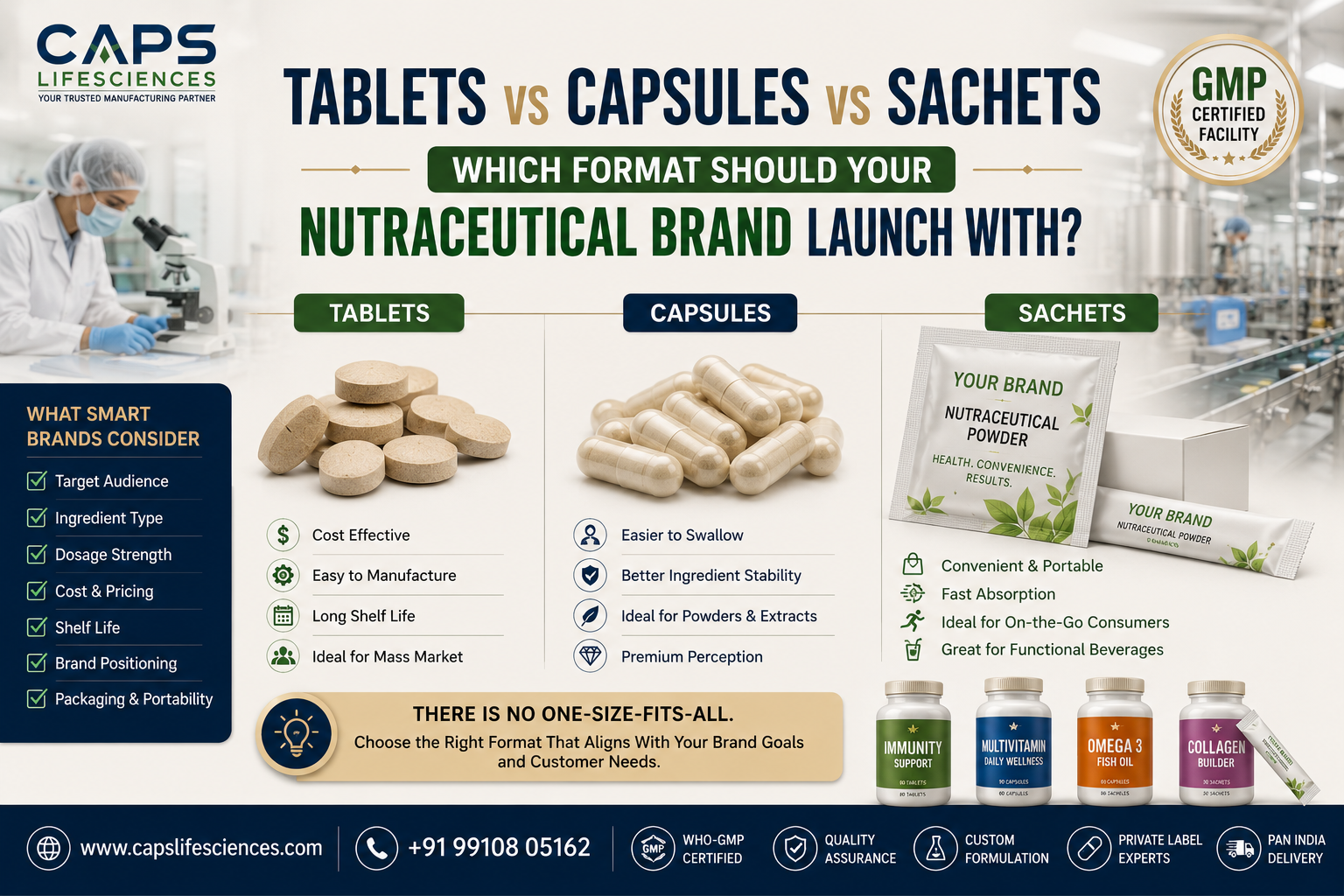
Standard tablet batches typically start at 50,000 to 100,000 units for commercial runs. Some manufacturers offer trial batches in the 10,000 to 25,000 range for new clients, often at a higher per-unit cost to account for setup and line time.
Hard Gelatin Capsules
Third party manufacturing MOQ for capsules is broadly similar to tablets — 50,000 units upward for standard commercial runs. For specialty HPMC vegetarian capsules, MOQs may be slightly higher because of raw material procurement constraints.
Sachets
Sachet manufacturing generally starts at 10,000 to 20,000 units for basic formats. Effervescent sachets often carry higher third party manufacturing MOQ — sometimes 50,000 and above — because the formulation and packaging process is more complex and machine setup time is significant.
Liquids
Liquid manufacturing batches are measured in litres rather than units. Minimum batch sizes typically start at 100 to 500 litres. In unit terms this usually translates to 2,000 to 10,000 bottles depending on fill volume.
Ayurvedic Formulations
Classical Ayurvedic products generally follow similar third party manufacturing MOQ ranges to nutraceuticals. Some classical formulations involving rare or seasonally sourced herbs may carry higher minimums tied to raw material procurement.
You can explore specific format capabilities and third party manufacturing MOQ details at our nutraceutical manufacturing page.
Trial Batches — When to Ask Your Third Party Manufacturing Partner
Most established manufacturers offer trial batches for new products or new clients. These are smaller runs — sometimes as low as 1,000 to 5,000 units — intended to validate formulation, confirm quality parameters, and give both parties a low-risk first run before committing to commercial third party manufacturing MOQ volumes.
Trial batches are worth requesting if:
You’re launching a new formulation that hasn’t been manufactured at this facility before. Running a trial lets you catch issues — poor compressibility, solubility problems, taste issues in sachets — before they show up in a 100,000-unit commercial batch.
You’re working with a manufacturer for the first time. A trial batch is as much a relationship test as a product test. You see how they communicate, handle queries during production, and how quality documentation comes together.
You’re entering a new market and need samples for regulatory submission or buyer evaluation before placing a full commercial third party manufacturing MOQ order.
One important point — trial batches almost always cost more per unit than commercial runs. Setup cost, line time, and QC effort are spread across fewer units. Factor this into your budget rather than being surprised by it.
Understanding Third Party Manufacturing Timelines Realistically
This is where expectations most frequently diverge from reality.
A manufacturer quoting a three-week turnaround sounds efficient. But that timeline often starts from when raw materials are ready — not from when you place the order. And raw material procurement is frequently the longest part of the entire process.
Here’s a realistic breakdown of what a first production run involves:
Week 1-2 — Order Confirmation and Raw Material Sourcing
Once you finalize formulation and commercial terms, the manufacturer raises purchase orders for raw materials. For standard ingredients this can move quickly. For specialty botanical extracts, imported raw materials, or ingredients with limited supplier availability, two to four weeks is not unusual — regardless of your agreed third party manufacturing MOQ.
Week 2-3 — Raw Material Testing and Approval
Every credible manufacturer tests incoming raw materials before releasing them for production. Identity testing, purity checks, microbial testing — this takes time. According to WHO GMP guidelines, incoming material testing is a mandatory GMP requirement — not an optional step a manufacturer can skip to save time.
Week 3-4 — Manufacturing
The actual production run — dispensing, blending, compression or filling, coating if applicable — typically takes two to five working days for standard batches. Liquids and effervescents may take longer due to process complexity.
Week 4-5 — Quality Control and Batch Release
Finished product testing is not optional. Dissolution testing, assay, microbial limits, weight variation, moisture content — specific tests depend on your product and dosage form. QC clearance typically takes one to two weeks. If an out-of-specification result comes up, add time for investigation.
Week 5-6 — Packaging and Dispatch
Primary and secondary packaging — bottling, blistering, labelling, cartoning — followed by final dispatch documentation and logistics.
A realistic first production run from order confirmation to dispatch is typically six to ten weeks. For complex formulations or first-time runs with a new manufacturer, ten to fourteen weeks is not unusual.
Any manufacturer promising you product in two weeks on a first third party manufacturing MOQ order is either cutting corners or hasn’t thought through what the process actually involves.
What Causes Delays in Third Party Manufacturing
Most production delays are predictable and preventable if you know what to watch for.
Artwork and packaging delays — Label artwork, carton design, and foil printing are frequently the bottleneck nobody anticipates. Start packaging development in parallel with formulation finalization — not after. This single habit saves two to four weeks on almost every project.
Incomplete documentation — Manufacturers need brand name approval documentation, label sign-off, and product specifications before production begins. Delays from your side directly push the production timeline.
Raw material availability — Certain ingredients have supply constraints — seasonal availability for some botanicals, import delays for specialty actives. Ask your manufacturer at formulation stage whether any key ingredients have known availability challenges.
Changes mid-process — Changing formulation, packaging format, or label content after production has begun is expensive and time-consuming. A week of extra review time upfront is worth significantly more than a mid-production change order.
What Affects Your Per-Unit Cost Beyond Third Party Manufacturing MOQ
Order volume — Higher volumes mean lower per-unit cost. Manufacturing economics improve as batch size increases and setup costs spread across more units.
Formulation complexity — A simple single-herb capsule costs less than a multi-ingredient effervescent sachet. More ingredients, more process steps, more testing — higher cost.
Raw material grade — Branded standardized extracts cost more than commodity botanicals. As FSSAI guidelines require, raw material specifications must be documented — which directly influences what grade your manufacturer sources.
Packaging type — HDPE bottles cost differently from blister packs. Carton quality, insert printing, and seal type all feed into the final cost.
Batch frequency — A manufacturer producing for you regularly will offer better pricing than one doing a one-off run. If you’re planning ongoing production beyond the initial third party manufacturing MOQ, make that clear early.
Final Thought
Third party manufacturing in India offers genuine advantages — established infrastructure, regulatory experience, competitive costs, and the ability to bring a product to market without building your own facility.
But it works best when both parties come to it with realistic expectations. Know your third party manufacturing MOQ requirements. Understand the timeline properly. Build your launch plan around what the process actually takes rather than what you hope it will take.
The brands that do this tend to launch successfully, build stable supply chains, and grow consistently.
Caps Lifescience handles third party manufacturing across tablets, capsules, sachets, liquids, and Ayurvedic formulations — working with both domestic brands and export-focused clients. Contact us to discuss your third party manufacturing MOQ and timelines, or visit our nutraceutical manufacturing page for full details.