Nutraceutical Brand India: The Complete Step-by-Step Launch Guide
Building a nutraceutical brand in India right now is one of the more credible business opportunities available — but only if you go about it the right way.
India’s nutraceutical brand market is projected to cross $18 billion by 2025-26. Consumers are spending more on preventive health, functional foods, and supplement-based wellness than at any previous point. The post-pandemic shift in health awareness accelerated a trend that was already building fast.
But thinking about launching a nutraceutical brand in India and actually doing it are separated by a very specific set of steps — regulatory, operational, and commercial — that most guides either gloss over or get wrong. This is a ground-level walkthrough of what it actually takes.
Step 1 — Get Specific About Your Nutraceutical Brand India Positioning
The nutraceutical brand India category is broad. Vitamins and minerals, herbal supplements, sports nutrition, women’s health, gut health, immunity, skin-from-within — these are all nutraceuticals, but they’re different businesses with different consumers and different competitive landscapes.
Before anything else, get specific. What product are you launching? Who is buying it? What problem does it solve, and why would they choose your nutraceutical brand over what’s already on the shelf?
Vague answers at this stage create expensive problems later. A brand built around “health and wellness” is not a brand — it’s a category. The brands gaining traction right now own a specific positioning, a specific consumer, and a specific benefit.
Step 2 — Understand Regulations Before You Formulate Your Nutraceutical Brand
This step gets skipped more often than any other and consistently causes the most damage.
Nutraceutical brand products in India are primarily regulated under FSSAI — the Food Safety and Standards Authority of India. Depending on your product type, you may also need to navigate AYUSH regulations if your formulation falls under Ayurvedic or herbal categories.
Under FSSAI, nutraceuticals fall under the Food Safety and Standards Regulations 2022 covering health supplements, nutraceuticals, and functional foods. This regulation defines permitted ingredients, dosage limits, and what claims you can legally make on your label.
Key things to understand before finalizing any formulation for your nutraceutical brand India launch:
Permitted ingredients — FSSAI maintains a positive list. If your key active isn’t on it or exceeds permitted dosage, you cannot legally sell without going through novel food approval.
Label claim restrictions — Disease claims are not permitted on nutraceutical labels. “Treats joint pain” puts you outside nutraceutical regulations entirely. Permissible claims are health maintenance and risk reduction oriented.
FSSAI license — Non-negotiable for selling any food or nutraceutical product in India. Even if your contract manufacturer holds the manufacturing license, you still need your own as the brand owner.
Step 3 — Develop the Right Formulation for Your Nutraceutical Brand
Once you know what’s permissible, develop a formulation that works both clinically and commercially. You have two broad options.
Working from an existing formulation — many contract manufacturers maintain standard formulations already developed, tested, and manufactured for other brands. You private label under your nutraceutical brand name. Faster, cheaper, and sensible for categories where ingredient differentiation isn’t your primary advantage.
Developing a proprietary formulation — if your nutraceutical brand India positioning depends on a unique ingredient combination or specific extract standardization, you’ll need custom development. This takes more time and costs more upfront, but creates genuine differentiation.
Whichever route you take, insist on stability testing before committing to a commercial batch. A formulation that degrades in six months or clumps in humidity damages your nutraceutical brand before it has a chance to build.
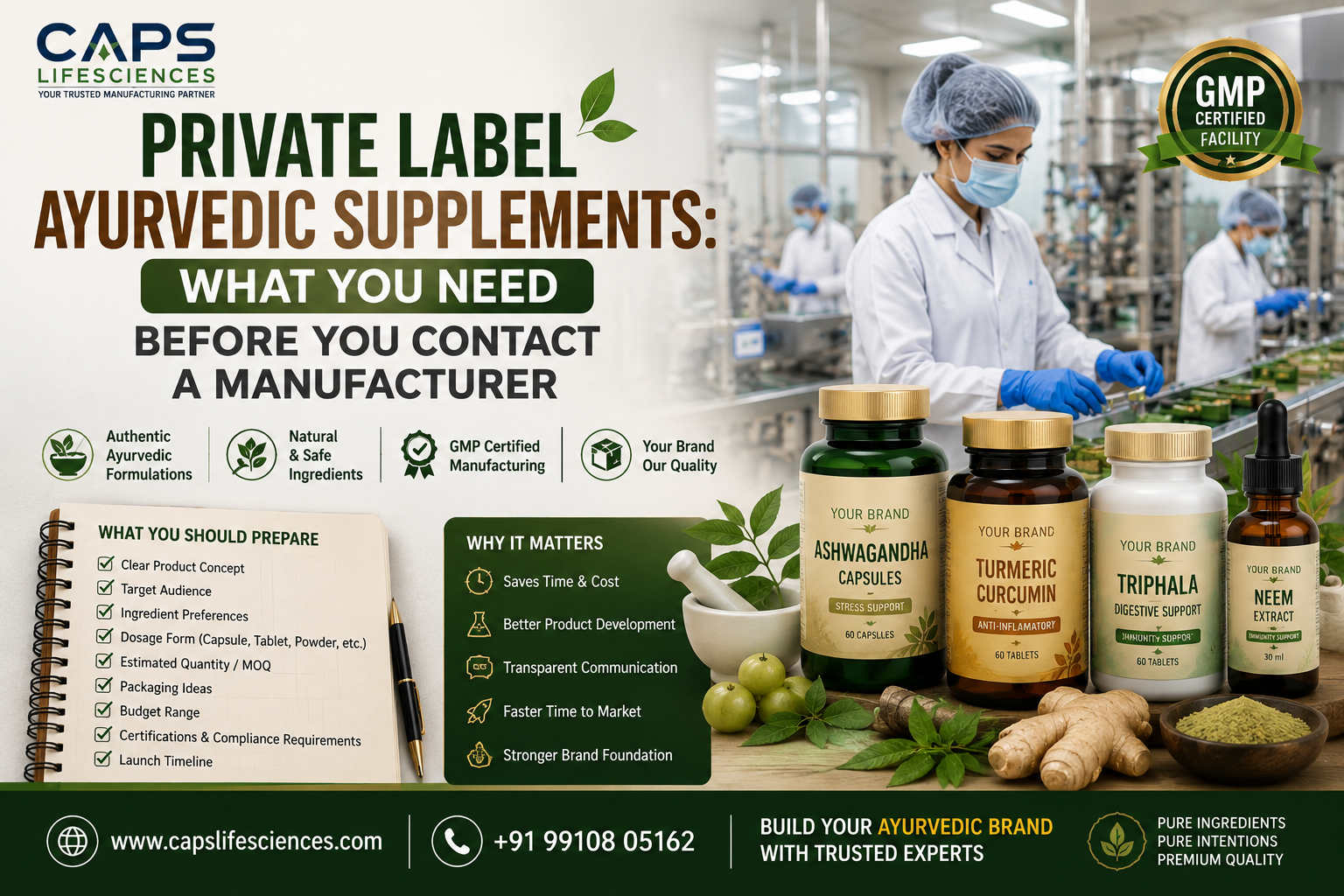
Step 4 — Choose the Right Manufacturing Partner for Your Nutraceutical Brand India Launch
This is arguably the most consequential decision in building a nutraceutical brand in India — and the one most people make with the least rigor.
Your contract manufacturer is your production partner, your quality system, and in many cases your regulatory support. A wrong choice affects not just one batch — it affects your nutraceutical brand’s reputation, timelines, and ability to scale.
Look beyond certifications on the brochure. WHO-GMP and ISO are the baseline, not the differentiator. What actually matters is whether the facility has specific experience with your dosage form and ingredient category, whether their QC is genuinely functional, and whether they communicate honestly when problems arise.
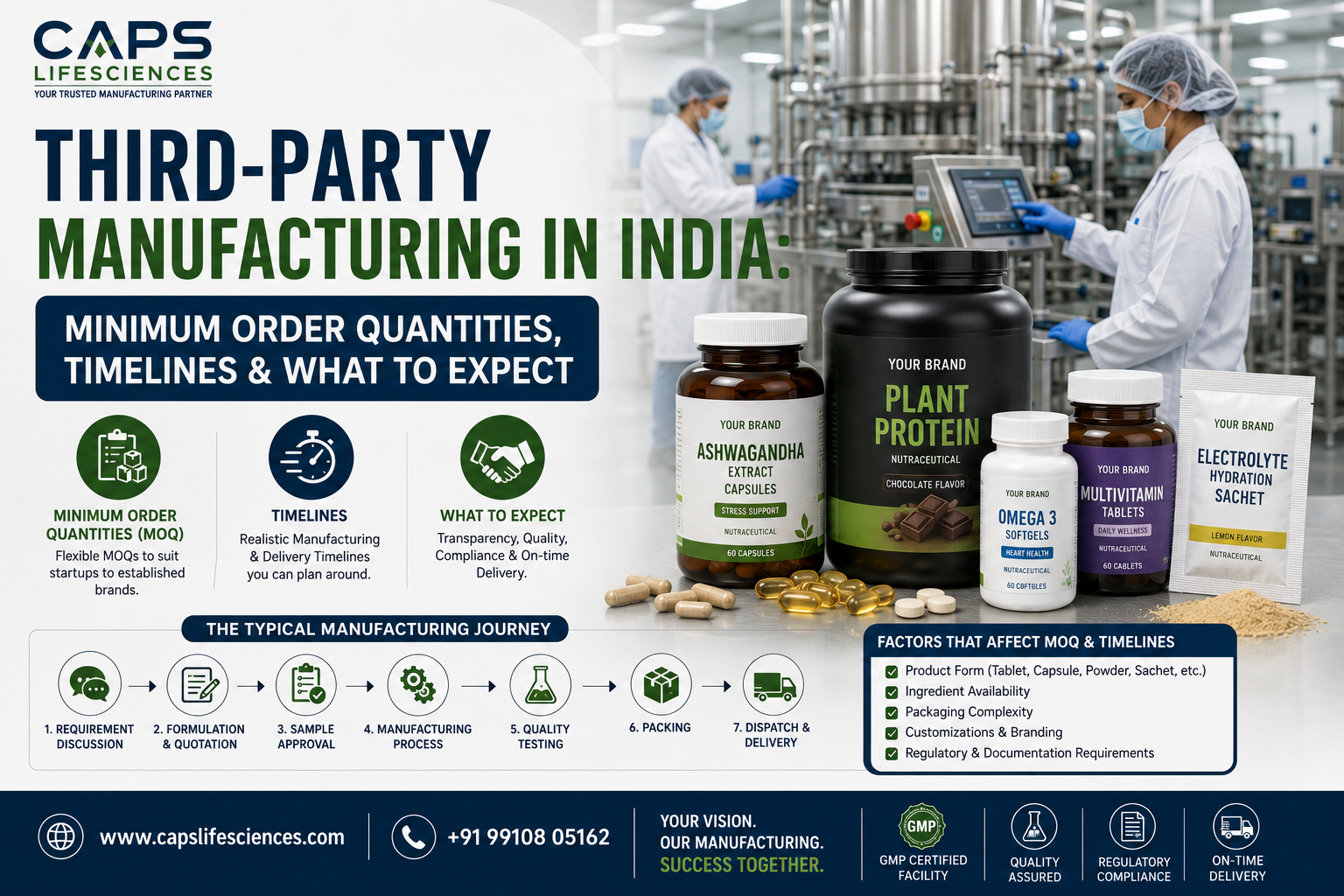
Visit the facility if you can. Clarify MOQs and timelines in writing. Verbal commitments in manufacturing have a way of becoming flexible when you need them to be firm. Learn more about what to look for at our nutraceutical manufacturing page.
Step 5 — Complete Your Nutraceutical Brand Business Registration
While formulation and manufacturing conversations are ongoing, business registration should move in parallel.
At minimum you need:
Business entity registration — Private limited company, LLP, or proprietorship. For a nutraceutical brand India with long-term intent, private limited is almost always the right structure.
FSSAI license — Non-negotiable for selling nutraceutical products in India.
Trademark registration — File for your nutraceutical brand name and logo under relevant classes as early as possible. Filing costs a few thousand rupees and protects everything you build on top of it.
GST registration — Required for commercial operations before you start invoicing.
For exports, also look into Import Export Code registration through DGFT — mandatory for any cross-border nutraceutical brand trade.
Step 6 — Design Packaging That Works for Your Nutraceutical Brand
Packaging does two things simultaneously for a nutraceutical brand India launch — it communicates brand to the consumer and meets regulatory labelling requirements. Both matter equally.
On the regulatory side, FSSAI mandates specific information on every nutraceutical label — product name, net quantity, ingredient list with amounts, nutritional information per serving, directions for use, storage conditions, manufacturer details, FSSAI license number, batch number, manufacturing date, expiry date, and MRP.
Beyond compliance, packaging is your first sales conversation with a consumer who has never heard of your nutraceutical brand. In a category where most products look the same, packaging that communicates clearly and builds trust is a genuine competitive advantage.
Step 7 — Plan Your Nutraceutical Brand India Route to Market
You have a product. Now how does it reach the consumer?
E-commerce — Amazon, Flipkart, and your own D2C site. Low entry barrier, national reach from day one, strong consumer data. Works well for nutraceutical brands with a clear differentiator and content-driven marketing.
Modern trade and pharmacy retail — Apollo Pharmacy, Wellness Forever, Health & Glow. Credibility and physical visibility, but listing fees, margins, and volume requirements are real barriers early on.
B2B and institutional — Gyms, wellness clinics, corporate wellness, healthcare practitioners. Lower volume per account but higher order values and stronger retention.
Most successful nutraceutical brand India launches start with e-commerce to build data and traction, then use that proof to negotiate retail listings.
Step 8 — Build Your Reorder System Before Your Nutraceutical Brand Needs It
The brands that struggle after a successful launch are almost always the ones that didn’t plan supply chain beyond the first production run.
Before your first batch ships, have a conversation with your manufacturer about reorder lead times, batch scheduling windows, and raw material availability for your next run. Build reorder trigger points based on realistic lead times — not optimistic ones.
Running out of stock three months after launch, when your nutraceutical brand is just building momentum, is one of the most damaging things that can happen. The consumer who couldn’t find your product once often doesn’t come back.
Final Thought
Launching a nutraceutical brand in India is genuinely achievable. The manufacturing infrastructure exists, the regulatory path is defined, and consumer demand is real and growing.
What separates brands that build something lasting from those that don’t is almost never the product idea. It’s execution on the fundamentals — right formulation, right manufacturing partner, clean regulatory foundation, and a route to market that matches actual resources.
Go through each step properly. Don’t rush the parts that feel slow. The nutraceutical brands worth building take a little longer to start — and considerably longer to stop.
Caps Lifescience is a WHO-GMP and ISO certified nutraceutical and Ayurvedic contract manufacturer in India, working with brands from first formulation to scaled commercial production. Contact us to discuss your product, or visit our nutraceutical manufacturing page to understand our full capabilities.